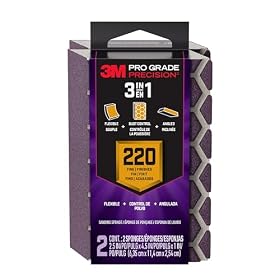
A detail sanding sponge is more forgiving on contoured surfaces, while a sanding stick offers a narrower, more rigid sanding surface for grooves, edges, and precise detail work. Choose based on the shape of the area and how much control you need.
A detail sanding sponge is usually the better choice for curved, irregular, or delicate surfaces, while a sanding stick is better when you need a narrow, firm abrasive surface for grooves, edges, or tight profiles. The right format depends less on the grit number than on whether the sanding surface needs to flex or stay rigid.
Detail sanding sponge versus sanding stick at a glance
Feature
Detail sanding sponge
Sanding stick
Sanding surface
Cushioned and somewhat flexible
Narrow and relatively rigid
Best for
Curves, contours, moldings, and small flat areas
Grooves, edges, slots, and precise profile work
Pressure control
More forgiving
More direct and concentrated
Risk of rounding edges
Higher if pressed too hard
Lower when the stick is kept square to the work
Conforms to curves
Well
Limited, depending on its shape
Access in narrow spaces
Moderate to good
Often very good
Typical use
Detail woodworking, paint preparation, craft work
Fine profile sanding, edge work, and hard-to-reach details
What is a detail sanding sponge?
A detail sanding sponge is an abrasive material attached to a compressible foam or sponge backing. The backing helps it conform to curves, rounded edges, carved areas, and uneven surfaces.
The cushioning also makes it less likely to leave a sharp scratch pattern from a hard sanding block. That does not mean it cannot damage an edge: heavy pressure can still flatten profiles or round corners.
Sanding around corners without cutting into the adjacent surface
Hand sanding areas that are too small for a standard sheet or sanding block
Sanding sponges are often available in several grits. Use a coarser grit for removing visible defects or old finish when appropriate, then move to progressively finer grits to reduce scratches before painting or applying a new finish. Follow the coating or finish manufacturer’s sanding recommendations when they are available.
Product prices and availability are accurate as of the date/time indicated and are subject to change. Any price and availability information displayed on Amazon.com at the time of purchase will apply to the purchase of this product.
What is a sanding stick?
A sanding stick is a narrow, firm sanding tool. It may have an abrasive surface built into the stick or use abrasive material wrapped, attached, or fitted around a rigid backing. Designs vary, so check how the particular product is intended to be used and whether the abrasive surface can be replaced.
Its main advantage is control. The narrow profile can reach channels, slots, inside corners, and other areas where a sponge is too wide. Its rigid backing also helps keep a flatter or more consistent sanding surface on a small edge or profile.
A sanding stick is useful for:
Narrow grooves and recesses
Small, straight edges
Fine adjustment of a joint or profile
Sanding between closely spaced details
Removing a small amount of material from a defined area
Because the abrasive area is narrow, it can concentrate pressure quickly. Use light pressure and make controlled passes to avoid creating a low spot or changing the shape of the detail.
Product prices and availability are accurate as of the date/time indicated and are subject to change. Any price and availability information displayed on Amazon.com at the time of purchase will apply to the purchase of this product.
Which format is better for common jobs?
Curved or carved surfaces: detail sanding sponge
Choose a detail sanding sponge when the surface is rounded, uneven, or carved. The flexible backing can follow the shape more easily than a rigid stick.
This is particularly helpful when preparing a decorative wood surface for paint or finish. Keep the sponge moving and use light pressure so it follows the profile rather than flattening the high points.
Narrow grooves and slots: sanding stick
A sanding stick is usually easier to control inside a narrow groove or channel. Its slim shape can reach the bottom or side of the detail without forcing a large sponge into the opening.
Before sanding, confirm that the stick fits without binding. If it is too wide, it may rub the sides unevenly or become difficult to move.
Sharp edges: sanding stick with a light touch
For a straight edge that needs precise sanding, a rigid stick can provide more direct contact. However, avoid aggressively sanding across the edge. A few extra strokes can remove more material than intended or soften the corner.
If the goal is to intentionally break or soften an edge, either format can work. A sponge is more forgiving for a subtle, hand-softened edge, while a stick offers more control over a small, defined area.
Uneven paint or finish: start with the format that matches the surface
For broad unevenness, neither a detail sponge nor a sanding stick may be the most efficient choice. A standard sanding sheet or block can cover a larger area more evenly.
Use a detail sponge around curves and a sanding stick for localized ridges, corners, or detail work. Avoid sanding only the most visible spot if doing so will create a dip or uneven sheen.
Between coats: sanding sponge for general work, stick for details
A fine sanding sponge is convenient for lightly scuffing many contoured or small surfaces between compatible coats of paint or finish. A sanding stick is useful when the coating has collected in a narrow recess or along a small edge.
Use minimal pressure. Between-coat sanding is usually intended to remove dust nibs or improve adhesion, not to strip the entire previous coat.
Product prices and availability are accurate as of the date/time indicated and are subject to change. Any price and availability information displayed on Amazon.com at the time of purchase will apply to the purchase of this product.
How grit affects the choice
The format and grit solve different problems:
Coarser grits remove material faster but leave deeper scratches.
Medium grits are commonly used for smoothing and surface preparation.
Fine grits reduce visible scratches and are useful for final preparation or light between-coat work.
The exact grit progression depends on the wood, coating, finish, and desired result. Do not assume that switching from a sponge to a stick means you should also change grit. Choose the grit for the amount of material you need to remove, then choose the format for the shape of the surface.
When changing to a finer grit, remove the previous grit’s scratches rather than sanding indefinitely in one place. Clean or vacuum the surface between grits so leftover abrasive particles do not create unexpected scratches.
How to choose between them
Choose a detail sanding sponge if you need to:
Follow a curved or irregular profile
Sand a small surface without a hard edge cutting into it
Prepare decorative wood or painted details
Work with a more forgiving hand-sanding format
Choose a sanding stick if you need to:
Reach a narrow channel or slot
Sand a small straight edge precisely
Keep the sanding surface relatively rigid
Remove material from one defined detail without using a wider abrasive
If the project contains both curves and narrow recesses, keeping both formats available is more practical than trying to make one substitute for the other.
Tips for better results
Clean the surface first. Dust and loose debris can create extra scratches.
Use light pressure. Let the abrasive do the work, especially with a rigid sanding stick.
Sand with the shape. On visible wood, finish with strokes that follow the grain when practical.
Check often. Stop and inspect the profile after a few passes rather than sanding continuously.
Use a sanding mask when dust is produced. Follow the product and coating safety instructions, and provide ventilation when working with paint or finish residue.
Do not use a loaded abrasive. If paint, finish, or dust fills the abrasive, replace or clean it according to the product instructions.
Bottom line
Use a detail sanding sponge for flexible, forgiving contact on curves, moldings, and irregular surfaces. Use a sanding stick for narrow grooves, small edges, and detail areas where a rigid, slim sanding surface gives better control. For the cleanest results, match the grit to the material-removal task and the format to the shape of the workpiece.
FAQ
Is a sanding sponge better than a sanding stick for wood?
Neither is universally better. A sanding sponge is generally more suitable for curved, contoured, or uneven wood, while a sanding stick is more useful for narrow grooves, small edges, and precise profile work.
Can a sanding stick replace a sanding sponge?
Only for some tasks. A sanding stick can handle narrow and defined areas, but its rigid surface may not follow curves as well as a sponge. It can also remove material quickly from a small area if too much pressure is used.
Can I use a detail sanding sponge on painted surfaces?
Yes, when the abrasive grit and coating instructions are appropriate. Use light pressure, control the dust, and avoid sanding through the coating unless removal is the goal.
What grit should I use with a detail sanding sponge or sanding stick?
Choose grit according to the material you need to remove and the finish you want. Start no coarser than necessary, then move to finer grits to reduce the scratches left by the previous abrasive.
When should I replace a sanding sponge or sanding stick abrasive?
Replace it when the abrasive is clogged, worn smooth, torn, or no longer cuts effectively. Continuing with a worn or loaded abrasive can encourage excessive pressure and produce uneven results.