9x11 Sheets vs. Pre-Cut 1/4 Sheets: Which Sandpaper Format Is Better?
Full 9x11 sandpaper sheets offer flexibility and lower waste when you need custom sizes, while pre-cut 1/4 sheets save time and fit common quarter-sheet sanding blocks. Here is how to choose between them.
What do you need help with?
Open an answer, or tell us what we should cover next.
Answered in this guide
Choose between 9x11 and pre-cut quarter sheets
Choose 9x11 sheets when you need custom sizes, different sanding methods, larger surfaces, or control over waste. Choose pre-cut quarter sheets when you use a matching sanding block, want less preparation, or sand small areas.
Neither format always wastes less. Full sheets can be cut or folded to use different areas, while pre-cut pieces may reduce waste when their size matches your block and the whole piece gets used.
Use pre-cut quarter sheets when they fit your quarter-sheet block. A full 9x11 sheet is more flexible when you have no block or need to fold, cut, or grip a larger sanding surface.
Use coarse grits to remove material or old finish, then move to finer grits as the surface becomes smoother. The sheet format does not choose the grit; the material and stage of work do.
Request a topic and help us choose what to build next.
Choose a sanding block that holds the paper securely
Plan how much sandpaper a project will need
Requests help us prioritize the next guide. No email required.
One anonymous request per topic.
9x11 sheets versus pre-cut 1/4 sheets
For most hand-sanding jobs, 9x11-inch sheets are the more flexible choice, while pre-cut 1/4 sheets are more convenient. A quarter-sheet is typically about 4.5 by 5.5 inches when a 9x11 sheet is divided evenly, but actual pre-cut dimensions can vary, so check the package before buying.
The better format depends on whether you value custom sizing and maximum material use or want sandpaper that is ready to attach to a quarter-sheet sanding block.
At a glance
Factor
9x11-inch sheets
Pre-cut 1/4 sheets
Best for
Mixed hand-sanding tasks and custom sizes
Fast, repeatable sanding with a quarter-sheet block
Preparation
Must be folded or cut
Ready to use
Flexibility
High
Limited to the pre-cut size
Fit with quarter-sheet blocks
Requires folding or cutting
Usually the simplest fit
Storage
Larger sheets
Easier to organize by grit
Waste control
Good if you cut carefully
Good for jobs using the entire small sheet
Best buying approach
Choose when grit and size needs vary
Choose when convenience matters most
What is the difference?
A 9x11 sheet is a full-size piece of abrasive paper commonly sold for hand sanding. You can use it whole, fold it around a sanding block, or cut it into smaller pieces.
A pre-cut 1/4 sheet is already divided into a smaller format intended for hand sanding or a quarter-sheet sanding block. If it is exactly one-quarter of a 9x11 sheet, its nominal size is approximately 4.5 by 5.5 inches. However, manufacturers may trim sheets differently, so do not assume every product has identical dimensions.
The abrasive type, backing, grit, and hole pattern matter more to performance than the sheet format alone. A pre-cut sheet is not automatically better or finer than a full sheet; it is simply supplied in a smaller size.
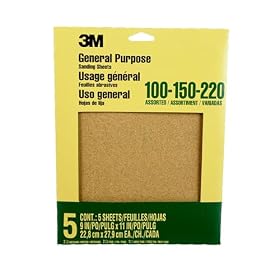
Full-size sheets for custom cutting and hand sanding
Product prices and availability are accurate as of the date/time indicated and are subject to change. Any price and availability information displayed on Amazon.com at the time of purchase will apply to the purchase of this product.
When 9x11 sheets are the better choice
You need different sizes for different surfaces
Full sheets can be cut into strips for edges, narrow trim, corners, or small repair areas. You can also fold a sheet to create a fresh sanding face as the abrasive wears.
This is useful when one project includes broad panels, narrow molding, inside corners, and detail work. You are not limited to the dimensions of a pre-cut piece.
You use several sanding methods
A full sheet can be used by hand, wrapped around a block, or cut to match a particular tool or accessory. Before cutting, confirm the size and attachment method required by the tool manufacturer.
Do not assume a quarter-sheet paper will fit every sanding block. Some blocks use clamps, hook-and-loop fasteners, or other attachment systems, and their required dimensions may differ.
You want to control waste
A 9x11 sheet lets you make larger or smaller pieces based on the condition of the abrasive. For example, a lightly used piece may still be suitable for sanding a rough edge even if it is no longer ideal for a large visible surface.
Careful cutting can also make full sheets economical when your project requires unusual shapes or sizes. On the other hand, if you routinely cut away most of each sheet, pre-cut pieces may be more convenient and create less handling waste.
You need a larger sanding surface
A full sheet gives you more abrasive area for broad hand-sanding passes. It can be useful for smoothing large tabletops, doors, shelves, or panels, although a sanding block or powered sander may be more efficient for extensive flat surfaces.
Use even pressure. Pressing harder does not necessarily remove material faster and can cause uneven wear, rounded edges, or premature loading.
Product prices and availability are accurate as of the date/time indicated and are subject to change. Any price and availability information displayed on Amazon.com at the time of purchase will apply to the purchase of this product.
When pre-cut 1/4 sheets are the better choice
You use a quarter-sheet sanding block
Pre-cut pieces are convenient when their dimensions match your block. They reduce setup time and make it easy to replace worn paper during a project.
Check whether the paper is designed for the block's attachment system. A quarter-sheet block with clamps may accept plain-backed paper, while a hook-and-loop block requires compatible backing.
You want less cutting and folding
Pre-cut sheets are useful for quick touch-ups, furniture repairs, painted trim, and other jobs where a small abrasive piece is enough. They are especially practical when you change grits often and want each piece ready to use.
You are organizing multiple grits
Smaller pieces can be easier to separate and label by grit. This helps prevent accidentally using a coarse abrasive during a final smoothing step.
Store abrasive paper flat and dry. Keep different grits in separate envelopes, bags, or compartments so loose grains from a coarse sheet do not contaminate finer paper.
You are sanding small surfaces
A quarter sheet is often sufficient for small boards, edges, repair areas, and detail work. It can also be easier to control by hand than a full sheet, particularly in tight spaces.
For hand sanding, fold the paper around a firm block when you need a flatter surface. Sanding with loose paper alone can follow dents and produce an uneven surface.
Product prices and availability are accurate as of the date/time indicated and are subject to change. Any price and availability information displayed on Amazon.com at the time of purchase will apply to the purchase of this product.
Which format wastes less sandpaper?
There is no universal winner. The answer depends on how much of the paper you can use before it loads, tears, or wears out.
9x11 sheets usually waste less when:
You need custom strips or partial pieces.
You work on both large and small surfaces.
You can reuse lightly worn sections for rougher work.
You need a size that is not available pre-cut.
Pre-cut 1/4 sheets usually waste less time and handling when:
Your sanding block uses that format.
You normally use one small piece at a time.
You switch grits frequently.
Cutting a full sheet would leave awkward scraps.
Compare the number of usable pieces rather than only the package's sheet count. A pack of full sheets may provide more total abrasive area, while a pack of quarter sheets may provide more convenient, ready-to-use pieces. Product labels may also list total square footage, which is a better comparison when available.
Consider the sanding block before choosing
The block determines whether either format is practical.
No block: A small pre-cut piece is convenient, but a folded full sheet may provide more grip and a fresh folding surface.
Clamp-style quarter-sheet block: Pre-cut quarter sheets are usually the quickest option if the dimensions match.
Hook-and-loop block: Use paper with the correct compatible backing rather than ordinary loose sheets.
Custom or irregular block: Full 9x11 sheets are easier to cut to size.
Detail or narrow-area sanding: Full sheets let you make narrow strips, though specialty detail abrasives may be more suitable.
Do not force paper into a holder that is too small or leave excess paper loose near a moving mechanism. Follow the sanding block or tool instructions.
How grit choice changes the decision
The sheet format does not determine the grit. Choose grit based on the material and the stage of work:
Coarse grits: Remove material, old finish, or prominent surface defects quickly, but can leave deep scratches.
Medium grits: Refine scratches and smooth general surface irregularities.
Fine grits: Prepare a surface for finish or improve smoothness after earlier sanding.
Very fine grits: Used for specific finishing or between-coat work when the finish system calls for it.
Move through grits gradually. Skipping too many steps can leave scratches that the next finer abrasive cannot remove efficiently. On painted or finished surfaces, use the finish manufacturer's recommendations, especially when sanding between coats.
Practical buying decision
Choose 9x11 sheets if you want one format that can be cut, folded, or adapted to several jobs. They are the better starting point for a mixed project or for anyone who does not yet know which sizes will be needed.
Choose pre-cut 1/4 sheets if you already use a compatible quarter-sheet block and want quick, consistent replacements. They are also a good fit for small repair and refinishing jobs where a full sheet would be unnecessarily large.
If you are unsure, buy the format that matches your sanding block first, then select the grits needed for the job. Confirm the actual sheet dimensions, backing type, abrasive material, and intended use before ordering.
Tips for getting more use from either format
Use the right pressure. Let the abrasive do the work instead of grinding it into the surface.
Keep the paper moving. This helps reduce uneven grooves and localized wear.
Change paper when it loads or stops cutting. A clogged sheet can create heat and encourage excess pressure.
Use a clean block. Dust and old abrasive particles can affect the finish.
Sand with the grain on wood for final passes. Cross-grain scratches are harder to hide.
Label leftover pieces. Record the grit before storing partial sheets.
Wear appropriate protection. Eye protection and dust control are sensible, and coatings or treated wood may require additional precautions.
Bottom line
9x11 sheets are best for flexibility, custom cuts, and mixed-size work. Pre-cut 1/4 sheets are best for convenience and quarter-sheet sanding blocks. If both formats use the same abrasive and backing, the main difference is how much preparation and waste you encounter—not the basic sanding action.
FAQ
Are pre-cut 1/4 sheets exactly one-quarter of a 9x11 sheet?
Not always. A true quarter of a 9x11-inch sheet is approximately 4.5 by 5.5 inches, but manufacturers may trim or size products differently. Check the listed dimensions before buying.
Can I use a 9x11 sheet in a quarter-sheet sanding block?
Usually, you can cut or fold it to fit a compatible quarter-sheet block, but the exact method depends on the block. Check its dimensions and attachment system before use.
Are 1/4 sheets cheaper than full 9x11 sheets?
Not necessarily. Compare the price per total abrasive area and how much of each piece you can use. Pre-cut sheets may cost more for convenience, while full sheets may create scraps if you only need small pieces.
Which format is better for furniture refinishing?
Either can work. Full sheets offer more flexibility for broad panels, edges, and custom strips, while pre-cut sheets are convenient for small areas and quarter-sheet blocks. Grit, backing, and abrasive quality are more important than format alone.
Should I use a sanding block with quarter sheets?
For flat surfaces, a firm sanding block generally gives more even pressure than loose paper. Use a block that matches the paper dimensions and attachment method, and follow the manufacturer's instructions.