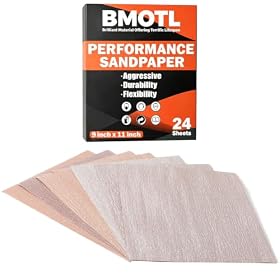
Sheets suit flexible hand sanding, discs are made for compatible power sanders, and sponges conform to edges and contours. Choose by tool, surface shape, and finish—not format alone.
Quick answer
Use sandpaper sheets for hand sanding, sanding blocks, and jobs that need paper cut to a particular size. Choose sanding discs for a compatible powered sander. Pick a sanding sponge for edges, profiles, and curved surfaces where a flat sheet is awkward.
The right format still depends on the abrasive grit, the surface, and whether your tool needs a particular attachment or dust-hole pattern.
Product prices and availability are accurate as of the date/time indicated and are subject to change. Any price and availability information displayed on Amazon.com at the time of purchase will apply to the purchase of this product.
How each format works
Sheets
Sheets are flat and can be used by hand or cut to fit many hand-sanding blocks. That makes them flexible for flat areas, corners, and small repair work. A block helps keep pressure even on flat surfaces; sanding with a folded sheet alone can concentrate pressure under your fingers and leave uneven marks.
Sheets are also easy to trim, but cut them only as directed for the tool or block. A sheet is not automatically compatible with a powered sander just because it can be made to fit. The attachment and dust-collection design must match.
Discs
Discs are round abrasives designed for specific powered sanders, commonly random-orbit sanders. They attach with hook-and-loop backing or a pressure-sensitive adhesive (PSA), depending on the tool. Check the sander’s instructions before buying: the disc diameter and attachment style need to match.
If the sander collects dust through holes in the pad, the disc’s hole pattern must also align. A disc with the wrong pattern may collect dust poorly or leave holes uncovered. Some discs are made without holes for sanders that do not use through-pad dust collection.
Sponges
Sanding sponges have abrasive surfaces attached to a resilient, shaped backing. They can follow gentle curves and work along edges or molded profiles more readily than a rigid block. Some have abrasive on multiple faces, which can make it easier to reach different angles.
Their flexibility is useful on contours, but it can be a disadvantage on broad, flat panels: pressure can vary as the sponge compresses. Use a flat block or suitable machine when keeping a surface plane is important. Sponge shapes and grit labeling vary, so check the package for the intended use and abrasive grit.
Product prices and availability are accurate as of the date/time indicated and are subject to change. Any price and availability information displayed on Amazon.com at the time of purchase will apply to the purchase of this product.
Choose by surface and task
Job
Usually the most practical format
Why
Flat surface sanded by hand
Sheet on a sanding block
The block helps distribute pressure evenly.
Small repair or a hard-to-reach corner
Sheet cut or folded to fit
You can adapt the paper to the work area.
Broad surface sanded with a compatible random-orbit sander
Disc
It is designed to attach to the sander’s pad.
Rounded edge, curved detail, or molded profile
Sanding sponge
Its backing can conform to the shape.
Flat finish work where levelness matters
Sheet on a flat block, or a compatible sander and disc
A controlled, even backing helps avoid dips and rounded edges.
These are starting points, not rules. For paint or finish removal, confirm that the abrasive and tool are appropriate for the coating and substrate. On wood, work through grits gradually; jumping too far ahead can leave scratches that show through the finish. Follow coating and tool instructions, and use suitable dust protection and ventilation.
Product prices and availability are accurate as of the date/time indicated and are subject to change. Any price and availability information displayed on Amazon.com at the time of purchase will apply to the purchase of this product.
Compatibility details that matter
Before buying discs, confirm the diameter, attachment type, and—if applicable—hole pattern required by your sander. A disc that is close in size or has a different backing may not attach or collect dust properly.
For sheets, check the dimensions and whether your sanding block uses clips, hook-and-loop, or another attachment. If you are cutting sheets, make sure the cut piece can be secured without exposed edges interfering with the work.
For sponges, look for the shape and firmness that suit the profile. Also check whether the abrasive is intended for dry or wet use; do not assume a sponge or paper is suitable for wet sanding unless its labeling says so.
Avoid common sanding mistakes
Using a sponge on a large flat panel: Its compressible backing may make it harder to keep the surface flat. Switch to a block or compatible powered sander if the surface needs to remain level.
Choosing a disc by diameter alone: Verify the attachment and dust-hole pattern, too.
Pressing harder to make sanding faster: Excess pressure can wear the abrasive quickly and leave uneven marks. Let the abrasive do the work, and replace it when it is clogged or worn.
Skipping grit progression: Move through appropriate grits rather than relying on a very fine abrasive to remove deep scratches.
Ignoring dust: Use the sander’s dust collection when available, and follow the tool and abrasive manufacturers’ safety guidance. Take extra care with dust from old coatings; do not sand potentially hazardous paint without identifying the risk and following applicable safety guidance.
FAQ
Can I use a sanding sheet on a random-orbit sander?
Only if the sheet is designed to attach to that sander and matches its pad size and attachment system. For dust-collecting models, the hole pattern should align as well. Check the sander manual.
Are sanding sponges better than sandpaper sheets?
Neither is universally better. Sponges are convenient for curved surfaces, edges, and profiles; sheets on a block give more control on flat areas and can be cut to fit.
Should I use a sanding disc or a sponge on a curved surface?
For hand sanding a curve or molded detail, a sponge can conform to the shape. A powered sander and disc may suit a broad, accessible curve if the sander is appropriate for the surface and can be controlled without flattening the profile.
Can sanding sponges be reused?
Some can be cleaned or reused, but follow the package directions. Replace a sponge when the abrasive is worn, clogged, torn, or no longer cuts evenly.