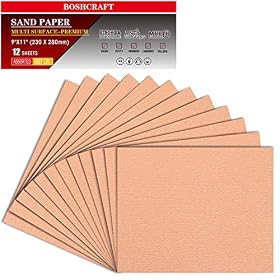
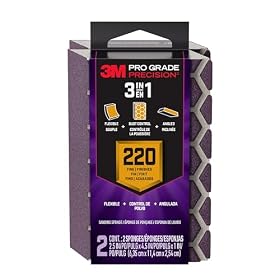
For a bare, solid-wood door with noticeable defects, use P80 only to remove high spots or deep scratches, then refine the surface with P120 and P150 or P180. If the door is painted, smooth, or veneered, start finer—or skip P80 entirely.
When to use P80 on a door
P80 is a coarse grit. Use it only when a bare, solid-wood door needs substantial leveling, such as removing rough saw marks or deep scratches. It removes material quickly but can leave scratches that show through stain or paint if you move on too soon.
Avoid P80 on thin veneer, delicate door edges, and painted surfaces you only plan to scuff before repainting. It can cut through veneer or damage the coating. For a sound painted door, follow the new paint manufacturer’s prep instructions; light scuffing with a finer grit is usually more appropriate than sanding down to bare wood.
Product prices and availability are accurate as of the date/time indicated and are subject to change. Any price and availability information displayed on Amazon.com at the time of purchase will apply to the purchase of this product.
A practical P80 to P180 sequence
For a bare, solid-wood door with significant surface defects, use this progression:
P80: Level only the rough areas. Keep the sander moving and use light, even pressure.
P120: Sand the P80 areas until the coarse scratches are gone and the surface looks uniform.
P150 or P180: Refine the surface for finishing. Use P180 when the finish instructions call for a finer final sanding; some finishes specify a different grit.
Do not jump straight from P80 to P180 if you can still see P80 scratches. The finer paper may take longer to remove them, and missed scratches can become more visible after stain or finish is applied. If the door is already fairly smooth, skip P80 and begin at P120 or finer.
Between grit changes, remove the dust and inspect the surface in good light. Sand with the wood grain where possible, especially on visible faces. On raised panels, molded profiles, and edges, hand-sand carefully rather than pressing a power sander into corners or thin sections.
Product prices and availability are accurate as of the date/time indicated and are subject to change. Any price and availability information displayed on Amazon.com at the time of purchase will apply to the purchase of this product.
Adjust the sequence for the door and finish
Bare solid wood with deep defects: P80, P120, then P150 or P180 may be appropriate.
Bare wood that is already smooth: Start at P120 or P150, then finish at the grit recommended for the coating or stain.
Painted door being repainted: Usually scuff the sound coating rather than stripping it with P80. Repair peeling paint and follow the coating instructions.
Veneered door: Use a fine grit and a light touch. If you are unsure how thick the veneer is, avoid coarse power sanding.
Between finish coats: Use the coating maker’s specified grit. P180 may be too coarse for some between-coat sanding; do not assume the same sequence applies.
If the door may have old lead-based paint, do not dry-sand it. Follow local lead-safe guidance or consult a qualified professional before disturbing the coating. Wear eye protection and suitable respiratory protection when sanding, and control and clean up dust carefully.
Check your work before moving on
Wipe or vacuum away dust, then look across the door under angled light. If you see distinct scratches, continue with the current grit until they are gone before stepping finer. If you notice a low spot, do not keep sanding the surrounding face aggressively; that can create a hollow. Address the surface defect with an appropriate repair method instead.
Replace a sheet or disc when it is clogged, worn, or no longer cuts efficiently. If the door is veneer and already sanded through, more sanding will not restore the surface; repair or refinishing may be needed.
FAQ
Can I go directly from P80 to P180 on a door?
It is usually better to use an intermediate grit such as P120. Move to P180 only after the P80 scratches are gone; otherwise, they may remain visible under the finish.
Should I use P80 on a painted door?
Not for routine scuff-sanding before repainting. P80 is aggressive and can cut through the paint or damage the wood. Follow the paint manufacturer’s preparation instructions and use a finer grit when appropriate.
What grit should I finish a bare wood door with?
P150 or P180 can be suitable, but the right final grit depends on the wood, stain, and finish. Follow the coating manufacturer’s instructions, since sanding too fine can affect stain absorption.
Can coarse sanding damage a veneered door?
Yes. Veneer can be thin, and P80 or heavy pressure can sand through it. Use a finer grit, work gently, and avoid aggressive power sanding.