A card scraper can take the place of 80-grit sandpaper when you need to remove glue, reduce tearout, or smooth a localized area of hardwood without leaving coarse sanding scratches. It is not a good substitute when you need to remove a lot of material or flatten a broad, uneven surface. For that, 80 grit is faster, though it leaves scratches that must be removed with progressively finer grits.
Comparisons · Sat Sep 19
Card scraper instead of 80 grit on hardwood
Use a sharp card scraper to remove glue, tearout, or small surface irregularities with control. Reach for 80-grit sandpaper when you need faster, broader material removal—but expect deeper scratches that need sanding out.
When a card scraper is better than 80 grit
A properly sharpened card scraper cuts thin shavings instead of abrading the wood. It can be useful for:
- Removing dried glue or small finish defects.
- Cleaning up localized tearout or a rough patch.
- Smoothing a surface while keeping dust down.
- Working near edges where aggressive sanding could round over a crisp detail.
The scraper needs a sharp, correctly formed edge to cut cleanly. If it only skates over the wood, chatters, or leaves a rough surface, stop and check the edge and your technique rather than pressing harder. Keep the scraper moving and use light, controlled passes; excessive pressure can dig in or leave uneven areas.
Follow-up paper after scraping or coarse sanding
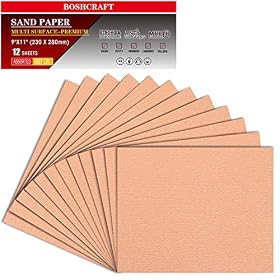 BOSHCRAFT 120 Grit Sand Paper 9" x 11", 12 Sheets – Premium Aluminum Oxide Sandpaper…BOSHCRAFT
$6.99 as of
View on Amazon Ali Industries 18726 9 x 11 in. 120 Grit SandpaperAli Industries
$14.80 as of
View on Amazon 9" x 11" Grit Professional Grade Sandpaper [Set of 20] Grit: 1203M
$18.99 as of
View on Amazon
Product prices and availability are accurate as of the date/time indicated and are subject to change. Any price and availability information displayed on Amazon.com at the time of purchase will apply to the purchase of this product.
When to keep the 80-grit sandpaper
Choose 80 grit when the job calls for fast material removal—for example, reducing a pronounced high spot or sanding a rough surface over a larger area. Use a sanding block for hand work or a suitable sander for the task, and keep it moving to reduce the chance of dips and gouges.
Because 80 grit is coarse, it usually is not a final sanding step on hardwood. Its deep scratches can remain visible under stain or a clear finish. After using it, move through finer grits in stages and check that each step removes the scratches from the previous one. The exact sequence depends on the wood, finish, and sander; test an inconspicuous area and follow the finish maker’s preparation guidance.
A practical choice-and-finish sequence
- Identify what needs to come off. For a little glue, tearout, or a small defect, try a sharp scraper. For substantial stock removal or a broad rough area, use sandpaper.
- Work a small test area. Check the surface under angled light. Stop if the scraper catches or the sander starts leaving a low spot.
- Inspect before moving on. A scraper may leave a surface smooth enough that you can begin sanding with a finer grit than 80, but don’t assume it has removed every mark. Use 80 grit only if the surface still needs substantial leveling or removal.
- Sand progressively if needed. Use finer grits in sequence, removing the previous grit’s scratches before advancing. Remove dust between steps and inspect again under angled light.
For an unknown or old coating, avoid dry-sanding until you know what it is and what precautions are required. Follow applicable safety guidance and the finish or tool manufacturer’s instructions.
FAQ
Can I use a card scraper to remove a finish instead of 80-grit sandpaper?
Sometimes, especially for a small area or a coating that comes off cleanly as shavings. A scraper is slower over a large surface, and some finishes may be difficult to scrape. Identify unknown coatings and follow appropriate safety guidance before disturbing them.
Does a card scraper replace sanding after scraping hardwood?
Not always. If the scraper leaves a clean, even surface, you may be able to start with a finer grit than 80. Inspect under angled light and sand as needed to remove remaining marks and prepare the surface for its finish.
Why does my card scraper leave rough marks instead of shavings?
The edge may be dull or improperly formed, or the scraper may be held at an ineffective angle. Check its sharpening and setup, then use light, controlled passes. Don’t compensate by pushing harder.