CAMI versus P-Grit Numbering: What the Labels Mean
CAMI and P-grit are separate sandpaper grading systems. Their numbers often line up at common grits, but they are not guaranteed to be exact equivalents.
What CAMI and P-grit mean
CAMI and P-grit are two standards for classifying abrasive particles in sandpaper. CAMI refers to the US grading system associated with the Coated Abrasives Manufacturers Institute. P-grit refers to the FEPA grading system for coated abrasives; its grades use a P prefix, as in P120.
In either system, a higher number generally means finer abrasive. But the number is a grade within a standard—not a measurement you can compare perfectly across every brand and product.
Product prices and availability are accurate as of the date/time indicated and are subject to change. Any price and availability information displayed on Amazon.com at the time of purchase will apply to the purchase of this product.
Are CAMI and P-grit numbers equivalent?
Often, common grades with the same number are close enough for practical sanding decisions. For example, CAMI 80 and P80 are broadly similar starting points. That does not mean the systems are identical or that every matching number will produce exactly the same surface.
The standards classify particle sizes and distributions differently, and products can vary by manufacturer and abrasive type. Treat cross-system comparisons as a guide, not a precise conversion. If a finish or product calls for a specific standard, follow that specification.
Sanding step
Commonly comparable labels
Practical use
Coarse
CAMI 60–80 / P60–P80
Removing material or leveling rough surfaces
Medium
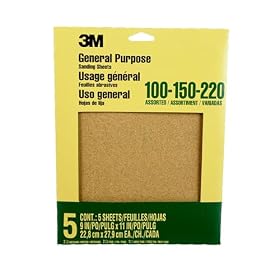
CAMI 100–150 / P100–P150
General smoothing and preparing surfaces
Fine
CAMI 180–220 / P180–P220
Final smoothing before many finishes
Very fine
CAMI 320 and higher / P320 and higher
Between-coat sanding or finer surface work, when appropriate
These are broad comparisons, not a promise of exact equivalence. Check the package for the grading system, especially when switching brands or following a finishing schedule.
Product prices and availability are accurate as of the date/time indicated and are subject to change. Any price and availability information displayed on Amazon.com at the time of purchase will apply to the purchase of this product.
How to choose when switching systems
Use the same grit number as a starting point when moving between CAMI and P-grit. At common grades, it is usually a reasonable approximation.
Follow the finish or coating instructions if they specify a grit and standard. Sanding too coarsely can leave scratches; sanding too finely can reduce adhesion for some coatings.
Keep the abrasive sequence consistent. Move through progressively finer grits and remove the scratches from the previous step before advancing. A large jump can leave visible marks behind.
Check the abrasive format and backing, too. A matching grit number does not make a sheet, disc, sponge, or mesh product otherwise interchangeable for every tool or task.
For wood, test the final grit on an inconspicuous area when the surface will be stained or finished. The wood species, coating, and sanding method can affect how scratches show.
The practical takeaway
CAMI and P-grit are different numbering standards, but matching numbers are often close enough to guide an ordinary grit choice. Use the P prefix to identify FEPA grades, treat crosswalks as approximate, and prioritize the product or finish maker’s specified grit when the result depends on it.
FAQ
Does P mean the sandpaper is finer than CAMI?
No. The P prefix identifies the FEPA grading system; it does not mean finer. Within either system, higher grit numbers generally indicate finer abrasive.
Can I use CAMI 120 instead of P120?
They are broadly comparable in common sanding applications, but they are not guaranteed to be exact equivalents. Follow a specified standard when a finish or process calls for one.
Why do some sandpaper packages show a P before the grit number?
The P identifies a FEPA grade for coated abrasives. CAMI grades are generally shown as a number without that prefix.