If you mean a cupped board, a hand plane can be a better choice than sandpaper when you need to flatten the face: it removes the high areas quickly. Sandpaper is gentler and useful for small corrections, but sanding a wide cup flat can take a long time. Either way, check how much thickness you can afford to lose before you start.
Comparisons · Wed Sep 23
A plane instead of sandpaper on a board cup
For a cupped board, a hand plane is often faster than sandpaper for removing the high areas. Sanding can work too, but use a long, rigid sanding board so it does not simply follow the cup.
When a plane is the better choice {#when-a-plane-is-the-better-choice}
Choose a plane when the cup is noticeable and the board has enough thickness to flatten. A hand plane cuts wood rather than abrading it, so it can remove high spots more efficiently than sanding. It is also easier to control than a powered belt sander, which can dig grooves or leave a face uneven if it is tilted or held in one place.
A plane does not automatically make a board flat. A short plane can ride over low areas, and a dull iron or unfavorable grain direction can cause tear-out. For a broad face, a longer plane helps you check and work toward a consistent surface. If you do not have experience setting and sharpening a plane, practice on scrap first or consider having the board flattened by a woodworker.
Rigid backing for flattening by hand
 Karebac Long Board Sanding Block (99460)Karebac
$15.80 as of
View on Amazon Rockler Benchtop Board Slab Flattening Jig – Precision Router Flattening Sled System for Wooden Slabs,…ROCKLER
$99.99 as of
View on Amazon
Product prices and availability are accurate as of the date/time indicated and are subject to change. Any price and availability information displayed on Amazon.com at the time of purchase will apply to the purchase of this product.
When sandpaper makes more sense {#when-sandpaper-makes-more-sense}
Use sandpaper for slight cupping, small high spots, or final surface preparation when preserving thickness matters more than speed. For flattening, attach the abrasive to a long, rigid, flat sanding board rather than sanding with a small folded sheet or soft pad. A short or flexible backing can follow the cup instead of correcting it.
Start with an abrasive coarse enough to remove the high areas without excessive effort, then move to finer grits to remove the earlier scratches. The right starting grit depends on the wood, the amount of material to remove, and the finish you plan to apply. Check progress often with a straightedge across the face; do not assume that a smoother-looking surface is flat.
Abrasive sheets for flattening and finishing
 3M Sandpaper, 60 Grit, 4 Sheets, 9 x 11 in, Coarse Aluminum Oxide3M
$5.34 as of
View on Amazon Furniture Clinic Sandpaper Sheets, Sand & Polish Wood Surfaces, 10 PackFurniture Clinic
$7.95 as of
View on Amazon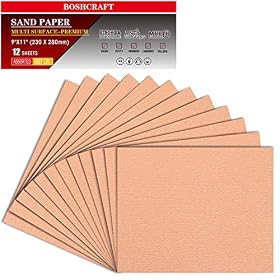 BOSHCRAFT 120 Grit Sand Paper 9" x 11", 12 Sheets – Premium Aluminum Oxide Sandpaper…BOSHCRAFT
$6.99 as of
View on Amazon
Product prices and availability are accurate as of the date/time indicated and are subject to change. Any price and availability information displayed on Amazon.com at the time of purchase will apply to the purchase of this product.
A careful way to flatten the board {#a-careful-way-to-flatten-the-board}
- Check the board first. Let it acclimate to the room where it will be used, and check whether the cup changes. If the wood is still moving as its moisture changes, flattening now may not last.
- Mark the high areas. Lay a straightedge across the face at several points. Pencil marks on the high areas make it easier to see where material is being removed.
- Choose the method. Use a plane for a substantial cup if you can control the tool and have enough thickness. Use a long sanding board for mild corrections or when you need to remove material more cautiously.
- Work gradually. With a plane, take controlled cuts and pay attention to grain direction to reduce tear-out. With sandpaper, keep the backing flat and use even strokes. Recheck across the width and length as you go.
- Stop when the face is flat enough for the job. Do not keep removing wood just to eliminate every cosmetic mark. Confirm that the finished thickness will still suit the project.
If the board is badly cupped, too thin to flatten safely, or twists as well as cups, a plane or sandpaper alone may not be the right fix. A woodworker can assess whether it can be flattened, or whether the board should be replaced. Once one face is flat, further surfacing the opposite face may require a planer or another suitable setup.
FAQ
Can sandpaper flatten a cupped board?
Yes, especially if the cup is slight, but it can be slow. Use sandpaper on a long, rigid, flat sanding board and check the surface with a straightedge as you work.
What grit should I use to flatten a cupped board?
There is no single correct grit. Choose one coarse enough to remove the high areas at a manageable pace, then use progressively finer grits to remove the scratches. Avoid starting finer than necessary if substantial material must be removed.
Will a hand plane remove too much wood?
It can if you take heavy or uncontrolled cuts. Check the board's thickness and project requirements first, take gradual cuts, and stop to check flatness often.